EU

South Africa Working Together to Improve the Fleet


The Johannesburg Automechanika event on 19 November 2024 provided an excellent opportunity for test station operators to engage with authorities on a wide range of topics, ensuring the effectiveness of roadworthiness inspections and test station operations. The Vehicle Testing Association (VTA) Imbizo (a Zulu word meaning "gathering of people") took place alongside the events and exhibitions of Automechanika.

CITA contributed to the event through Chantal Abou Jaoude from Maha, who presented on Best Practice Recommendations from Africa and the Middle East, showcasing current developments in Egypt and Saudi Arabia. Eduard Fernandez, Executive Director of CITA, introduced the organization, highlighting its extensive constituency, significant body of work, and active task teams.

In South Africa, the regulatory framework governing test station operations and roadworthiness processes operates on three levels. The National Department of Transport is responsible for policy and regulatory matters, while the individual Provincial Mobility/Transport Departments oversee the registration and supervision of operators within their provinces. Additionally, the Minister of Transport has appointed an Inspectorate of Testing Stations, which resides within the Certification division of the South African Bureau of Standards.

All roadworthy inspection results are recorded in the NATIS (National Traffic Information System)—a centralized, government-owned database of vehicles, vehicle owners, and drivers. The system is managed by the lead agency for road safety in the country, the RTMC (Road Traffic Management Corporation).

South Africa has over 500 test stations, the majority of which are privately operated. These private stations have organized themselves into various industry bodies, with the largest being the VTA (Vehicle Testing Association), part of the RMI (Retail Motor Industry). The RMI represents 8,700 motor-related businesses serving the aftermarket sector, including vehicle testing stations. Ferose Oaten, a board member of CITA and Chairperson for CITA RAG Africa, also serves as the National Chairperson of the VTA in South Africa.

At the Automechanika VTA Imbizo, all the aforementioned authorities presented on various topics. These included the digitization of inspection reports, the integration of multiple databases with the NATIS system, trends of non-compliance within the industry, local provincial issues, proposed policy changes to include alternately powered vehicles, and other relevant topics.

Regarding legislative requirements for roadworthiness tests, private vehicles are only required to be inspected upon a change of ownership. Heavy goods vehicles and taxis must undergo annual inspections, while buses are required to have roadworthiness inspections every six months. South Africa currently has 13.9 million vehicles, of which only 21% of the fleet are required to undergo roadworthy inspections under the current regulations. In 2014, the Minister of Transport published legislation to implement periodic technical inspections for vehicles older than 10 years every two years. However, this provision, although published, will only be implemented “at a date determined by the Minister.”


EU should set mandatory safety standards for e-scooters


Brussels - A new report published today by the European Transport Safety Council calls for the development of mandatory technical requirements for all e-scooters sold in the European Union to replace the current patchwork of national requirements, and voluntary standards. The standards should include a speed limiter set at 20 km/h as well as stability, minimum braking and maximum acceleration requirements, according to ETSC.

The researchers recommend that national governments set a minimum age of 16 for e-scooter riders, a requirement for mandatory helmets, as well as a ban on riding after consuming alcohol or drugs or riding with passengers.

Jenny Carson, co-author of the report said: “E-scooters are now an established and popular way of getting around in urban areas in the EU. However, they also come with a degree of risk that needs addressing more effectively than today. With the right combination of a safer urban traffic environment, safer vehicles and safer rider behaviour, we can ensure that the roads are safer for e-scooter riders as well as cyclists and pedestrians.”

In national data from European countries, the researchers found 119 road deaths in 2022 in collisions involving ‘motorised micro-mobility devices’ – a category of personal light electric vehicle that is dominated by e-scooters but also includes rarer vehicles such as electric unicycles. While this figure was an increase on previous years, that may be due simply to increased numbers of e-scooter riders. The researchers are calling for more data on e-scooter usage to understand better the risk levels, which, according to some previous analyses, are higher than for cycling.

Many crashes and injuries involving e-scooters only involve the rider, and no other road users. In such cases, police may not be called to the scene, leading to the possibility that the collision is not reported in national data. More needs to be done at national level to link hospital data to police records in order to gain a fuller picture of injury rates.

Reported e-scooter-related deaths often involve alcohol, with the limited data available showing that between half and two-thirds of those killed had consumed alcohol before riding. Countermeasures against drink-riding should include legal limits with appropriate levels of enforcement. In Finland and Norway, city authorities have required shared e-scooter providers to limit speed at night, or banned shared e-scooters altogether during night hours - measures which resulted in a reduction in injuries.

30 km/h speed limits in urban areas are one of the main tools cities can use to reduce the risks for e-scooter users in urban areas. Drivers of cars, vans and lorries travelling at 30 km/h or less are much less likely to kill vulnerable road users such as e-scooter riders, pedestrians and cyclists.
Some existing EU product regulations apply to e-scooters, for example rules covering machinery and batteries, however there is no mandatory single standard for e-scooters covering factors such as stability, maximum speed and braking performance. In the absence of EU regulation, several EU member states including Germany and Spain, have developed their own national standards for the vehicles. ETSC recommends that the EU develop a single set of mandatory technical requirements, including a mandatory top speed limit of 20 km/h, set at the factory. 11 European countries already require a 20 km/h maximum speed for e-scooters at national level.

New standards should also require a minimum level of braking performance, a limit on maximum acceleration, front and rear brakes, an audible warning device (such as a bell), as well as front and rear lights, according to ETSC.

The EU has mandatory safety standards for new cars, vans and lorries which include the fitting of automated emergency braking systems that can help prevent crashes with pedestrians and cyclists. However, such systems are not currently required to recognize e-scooter riders. ETSC says the standard needs to be updated soon, as it takes years for new safety technologies to reach the majority of all vehicles on the road.


Download the report at: www.etsc.eu/pinflash47
The European Transport Safety Council is the independent voice for road safety in Europe www.etsc.eu

ETSC’s Road Safety Performance Index (PIN) programme receives financial support from the German Road Safety Council (DVR), Toyota Motor Europe, the Norwegian Public Roads Administration, CITA – the International Motor Vehicle Inspection Committee and Fundación MAPFRE.

For further information:
Dudley Curtis, Communications Manager, dc@etsc.eu

First CITA ADAS TaskForce Face-to-Face Meeting


On the 4th and 5th of November 2024, members of the CITA ADAS Task Force convened for a first face-to-face meeting aimed at advancing methods for testing Advanced Driver Assistance Systems (ADAS) within the framework of vehicle technical inspections (PTI). The event gathered experts from CITA Members' organizations, including TÜV, ÖAMTC, FSD, MAHA, UTAC, RDW, AVL, HELLA, GTÜ, KÜS, KOTSA, DÜRR, and DEKRA, each bringing valuable insights into the evolving landscape of ADAS system evaluations.

The two-day event was held across two locations in Germany. The first day was hosted at the KÜS-Bundesgeschäftsstelle in Losheim am See, providing an ideal setting for practical demonstrations and collaborative discussions. On the second day, participants gathered at Dürr Assembly Products GmbH in Püttlingen, where they explored advanced testing platforms specifically tailored to ADAS systems.

With ADAS features becoming standard in modern vehicles, ensuring the functionality and accuracy of these systems through regular inspections has become a critical safety concern. The primary objective of this meeting was to present and discuss solutions for integrating ADAS checks within PTI processes, ensuring that these advanced systems remain effective and reliable over the vehicle's lifecycle.

Throughout the two days, participants were exposed to cutting-edge technologies and research that showcase the potential of ADAS testing within technical inspections. Each presentation offered a unique perspective on practical applications, existing implementations, and future directions for ADAS evaluation in PTI.


Day 1: Losheim am See

KÜS Drive Research Project: The KÜS team led a live demonstration of their ADAS system evaluation test bench, showcasing how it could seamlessly integrate with current PTI evaluations. This adaptable solution underscores the feasibility of implementing ADAS checks without overhauling existing inspection infrastructures.

DEKRA & GTÜ Inspection for Sensors: Representatives from DEKRA and GTÜ demonstrated a front radar sensor inspection model, currently part of lighting inspections in some PTI centers. This model highlights the potential of adapting existing tools and processes to verify ADAS components without excessive cost or complexity.

KOTSA Integrated Inspection Platform: KOTSA presented their Integrated Inspection Systems approach, currently in use in South Korea, where ADAS inspections are embedded within PTI activities. This system demonstrates a comprehensive model for integrating ADAS checks into the vehicle inspection process, offering a glimpse into scalable solutions applicable worldwide.

Day 2: Püttlingen

DÜRR Test Bench: DÜRR facilitated another live demonstration of their ADAS evaluation test bench, showing its compatibility with current PTI processes. The DÜRR solution emphasizes efficiency, making ADAS testing feasible as an addition to standard PTI checks.

FSD Charter 2030 Project: The FSD team shared insights from their Charter 2030 initiative, a forward-looking project aimed at defining the long-term goals of PTI. This presentation helped underline the future vision for ADAS verification within technical inspections.

MAHA ADAS Testing Project – Today & Tomorrow: MAHA presented their ADAS testing project, which addresses both present and future needs for ADAS system evaluation within PTI. Their approach balances current requirements with the evolving complexity of ADAS features, offering a versatile model for future-ready inspections.


The collaborative discussions and demonstrations during the meeting solidified the CITA Task Force's commitment to making ADAS testing an integral part of vehicle inspections. By evaluating solutions that are adaptable, scalable, and effective, CITA and its Members are paving the way for regulatory standards that will ensure ADAS reliability, ultimately contributing to safer roads worldwide. CITA looks forward to continuing this momentum, working with global partners and regulatory bodies to bring these essential solutions to fruition.


CITA International Conference & 24th GA in Istanbul


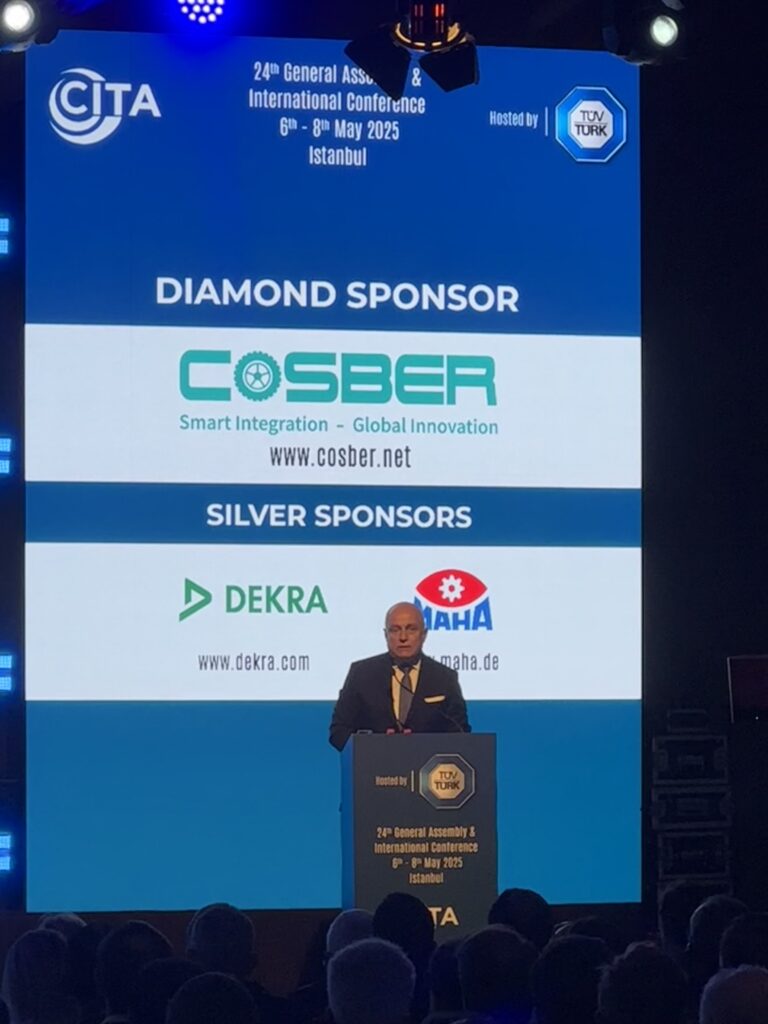
We are thrilled to announce the upcoming CITA International Conference and 24th General Assembly, set to take place from May 6-8, 2025, in the vibrant city of Istanbul, Turkey. Hosted by TÜVTÜRK, this landmark event will bring together thought leaders, policymakers, industry experts, and stakeholders from around the globe, gathering under the theme: “Forging Global Alliances for Safer Roads and a Greener Future.”

The CITA International Conference has long been a nexus for innovation and collaboration in the vehicle inspection and road safety sectors. This year, attendees will engage with pressing issues shaping the future of transportation, discussing vital topics that underscore CITA’s commitment to advancing safer, more sustainable mobility.

Event Highlights
The conference will explore key topics influencing the trajectory of vehicle inspection, road safety, and environmental sustainability:

  • Opportunities and Challenges in LMICs: Unique perspectives and strategies for enhancing vehicle inspection and safety standards in low- and middle-income countries.
  • New Technologies & Data Management: The role of cutting-edge technologies and data management in revolutionizing vehicle inspection processes.
  • Environmental Protection: Measures and innovations aimed at reducing emissions and supporting cleaner transportation solutions.
  • Advanced Inspection Procedures: Enhanced inspection methodologies to increase road safety and ensure compliance.
  • Growth and Impact of Electric Powertrains: Analyzing the surge of electric vehicles and their influence on vehicle inspection protocols.
  • Decarbonization: Collaborative approaches for reducing carbon emissions in the automotive sector.
  • Vehicle Approval: Updates and developments in vehicle approval and compliance.

On the morning of May 6, CITA members will convene for the 24th General Assembly, an exclusive session dedicated to shaping CITA’s future initiatives and strengthening its network.

Registration & Special Offers
Don't miss your chance to participate in this global gathering. Registration is open until April 25, 2025, with an Early Bird discount available until January 17, 2025. Attendees can benefit from special rates at the Renaissance Polat Istanbul Hotel, the official conference venue, providing a convenient and comfortable stay in the heart of Istanbul.

Sponsorship and Exhibition Opportunities
The CITA International Conference is the ideal platform for organizations looking to showcase their brand to an international audience. Our sponsorship and exhibition programs provide unique opportunities for visibility, networking, and advancing the cause of safer, greener transportation. Companies interested in partnering with us are encouraged to explore these programs and join us in making this event a transformative experience.

Join us in Istanbul to contribute to the global dialogue on road safety, sustainability, and technological advancements in vehicle inspection. Together, we can forge alliances that make roads safer and support a cleaner, more sustainable future.


Protecting Public Interest in the Used Car Market


On November 5, 2024, CITA, in collaboration with carVertical, hosted an enlightening webinar titled “How does the protection of the public interest shape used car market transparency?”. Led by carVertical’s Head of Communications, Matas Buzelis, the event addressed critical issues surrounding odometer fraud, a common and costly problem that artificially inflates car values. Citing recent data, carVertical highlighted the financial impact of odometer manipulation across Europe, with buyers in some countries overpaying by up to 25% for tampered vehicles.

The speaker discussed carVertical’s “Market Transparency Index,” a signature tool that leverages millions of vehicle history reports to rank and compare transparency levels across several countries. The index evaluates critical factors such as odometer fraud rates, historical damage records, import data, and average vehicle age, which are crucial for consumers to make informed decisions and avoid scams.

Cross-border car trade, which offers consumers a wider selection of vehicles and competitive prices, was also explored. However, it was noted that this trend can lead to increased fraud due to inconsistent data exchange between countries. carVertical highlighted the importance of robust digital data and collaborative efforts among institutions to mitigate these risks and safeguard consumers.


SGS Convention Highlights


The SGS Convention, held on October 12, 2024, in Brussels, brought together employees and franchised companies from across France for an afternoon of key discussions and networking. The event focused on the latest advancements in the technical control of two-wheeled vehicles, an increasingly important issue across Europe.

A highlight of the convention was the participation of Mr. Eduard Fernández, Executive Director of CITA, who engaged in a Q&A session. He provided an overview of CITA and shared updates on European directives affecting vehicle inspections.

Mr. Fernández emphasized that some countries have successfully implemented motorcycle inspection programs, improving safety, vehicle maintenance, and reducing pollution. He also addressed the ongoing revisions to the European directive on vehicle inspections, which aim to expand safety checks, emissions testing, and data-sharing among member states.


The 14th Florence Intermodal Forum: Road Safety


The 14th Florence Intermodal Forum, which took place on 11 October 2024 at Villa Schifanoia in Florence, brought together key stakeholders to discuss road safety and the utilization of data generated by connected vehicles for the public good. The event was co-organized by the Florence School of Regulation’s Transport Area, the European Commission's DG MOVE, and DG GROW, and centred around critical questions regarding how vehicle data can be harnessed to enhance road safety across Europe.

Gerhard Müller, the President of CITA, made a significant contribution to the discussion with his presentation, in which he introduced CITA's work and underscored the pivotal role of data access for vehicle inspections. Müller emphasized that data is crucial for evaluating both safety and emissions behaviour in vehicles, which are critical to the development of safer and more environmentally responsible transport systems.

During the subsequent discussion, Müller expanded on key issues regarding data ownership, vehicle automation, and the need for coherent legislation across Europe. He clarified that, generally, drivers own the data generated by their vehicles, not the OEMs. This distinction is important as it reflects a need for clear frameworks to protect drivers' rights while ensuring the responsible use of data in public safety initiatives.

One of Müller’s key messages was the call for at least EU-wide legislation to govern these developments, noting that national-level legislation would be insufficient. With vehicles crossing borders and new technologies rapidly evolving, a unified European approach is necessary to create consistent standards across the EU.

Müller also stressed the need to balance competitiveness with safety. He argued that the better the automated functions of vehicles are, and the safer European vehicles become, the more competitive they will be on the global market. By focusing on safety improvements, European vehicles can not only protect their users but also maintain a strong competitive edge.

Finally, Müller called for European legislation to become more flexible and quicker in its response to the fast pace of technological advancements in modern vehicles. The automotive industry is evolving rapidly, and legislation needs to keep up to ensure safety while fostering innovation.


A Technical Exchange Between Finnish and Italian PTI Associations


On October 4th, a technical exchange took place in Catania, Italy, organized by FederIspettori who hosted the Finnish association Yksityisten Katsastustoimipaikkojen Liitto ry, presided over by Björn Ziessler. This event underscored the value of international cooperation and shared learning within the vehicle inspection sector, highlighting the fruitful relationship fostered through both associations' membership in the CITA. It is thanks to CITA that such meaningful exchanges become possible, promoting shared standards and collaboration across borders.

The first phase of the exchange involved an in-depth presentation by FederIspettori on the Italian vehicle inspection system, including an honest overview of its critical points and challenges. The event then shifted to the practical side, featuring visits to key inspection facilities in the Catania area. The delegation started by visiting a light vehicle inspection center, followed by a visit to the Motorizzazione Civile of Catania. In the afternoon, the group continued their exploration by visiting a heavy vehicle inspection center, offering a more comprehensive view of how vehicle inspections are managed across different sectors in Italy.

Special thanks go out to all partners who generously made their facilities available for these visits (Regione Sicilia for granting access to the Motorizzazione Civile of Catania, Revauto Srl for the heavy vehicle inspection center, and Centro Revisioni Pit Stop Sorbello for hosting the light vehicle inspection line) and the impeccable organization and hospitality of the Sicily section of FederIspettori.

A new CITA member from Portugal: IMT, I.P.


The Instituto da Mobilidade e dos Transportes, I.P. (IMT, I.P.)'s mission is to exercise technical regulation, licensing, coordination, inspection and planning functions in the field of land and river transport and their respective infrastructures, as well as in the economic aspect of commercial ports and maritime transport sector.

In the field of land transport it’s main activities are:

  • Authorise public passenger transport services;
  • Authorise, license and supervise the exercise of land transport and complementary activities, including coordinating the licensing process and the management of platforms and other logistics facilities, under the terms of the applicable legislation;
  • Certifying land transport professionals and promoting driver licensing, recognising, licensing and supervising the training and examination centers subject to its supervision;
  • Define the conditions for issuing, revalidating, exchanging and seizing driving licences and professional certificates.
  • Monitoring the application of social regulations in the field of road transport, as the national authority responsible for implementing the respective control instruments (tachographs);
  • Approving, homologating and certifying vehicles and equipment used in land transport systems, guaranteeing the required technical and safety standards, licensing the entities involved in the certification and inspection processes;
  • Promoting technical improvements in road and rail vehicles, with the aim of improving safety and efficiency in the operation of road and rail transport, interoperability and reducing negative environmental impacts.
  • Ensuring the management of national registers in the transport sector, namely of vehicles, inspection centres, drivers, driving schools, transport companies and complementary activities, public passenger transport services and transport professionals, and railway infrastructures;
  • Managing the standards and processes of the electronic vehicle identification system;

Please visit their website

CITA EU Manifesto for a Sustainable and Safer Road Transport Future


As the EU prepares for its new institutional mandate, CITA is dedicated to ensuring that emerging vehicle technologies drive a safer, cleaner, and more efficient road transport system. With vehicles playing a crucial role in society and the economy, we are at a pivotal moment to maximize technological advancements while addressing key challenges in road safety and sustainability.

A Regulatory Framework for the Future

The upcoming EU mandate will shape how vehicle technologies influence Europe's transport landscape. CITA calls for a regulatory framework aligned with the UN Sustainable Development Goals, Vision Zero, and climate action, focusing on these key areas:

  1. Comprehensive Vehicle Oversight
    The European Commission must establish necessary structures to provide a coordinated and comprehensive overview of vehicle regulation throughout their legal lifespan. This approach ensures that vehicles remain compliant with safety and environmental standards, from production to end-of-life.
  2. Integrated Decarbonization and Safety
    Decarbonization efforts must consider road safety and emission controls to protect both people and the environment.
  3. Support for New Technologies
    A strong regulatory framework is needed to ensure the safe and harmonized implementation of new technologies across the EU.
  4. Fair Access to Vehicle Data
    Ensuring equitable, cost-free access to vehicle systems and data for essential government functions, including approval and inspection processes.
  5. Risk-Based Vehicle Regulation
    A smarter approach to regulation should focus on vehicle risks, such as age and condition, ensuring that higher-risk vehicles are prioritized.
  6. Addressing New Transport Modes
    Regulatory frameworks must incorporate emerging transport modes, such as micromobility, to ensure their safe integration.

Key Priorities for the Next Five Years

Vehicle self-diagnosis systems like ADAS are essential but insufficient for full compliance. In the next mandate, CITA recommends:

Transparency in Electric Vehicle Fleets
Develop impartial assessments of electric vehicle batteries, especially their state of health, to ensure fleet electrification progresses responsibly.

Evaluation of Advanced Driving Systems
Create reliable, impartial methods to assess ADAS and autonomous systems throughout a vehicle's lifespan to maintain safety standards.

Finalizing the Roadworthiness Package
Complete the development of particle and nitrogen oxide emission testing to ensure vehicles meet environmental standards.

CITA is committed to collaborating with policymakers and industry stakeholders to build a regulatory environment that balances innovation with safety and sustainability.

By addressing the critical issues outlined in this manifesto, we believe the next EU mandate can unlock the full potential of new vehicle technologies while making significant strides toward achieving Europe’s sustainability and road safety goals.