
New UN Framework for Safer & Cleaner Used Vehicles Adopted
Geneva, 18 November 2026 — The international community has taken a significant step forward in improving road safety and environmental protection with the adoption of a new United Nations Resolution on the Inspection Criteria for Used Vehicles by the World Forum for Harmonization of Vehicle Regulations (WP.29).
The Resolution establishes, for the first time, an internationally recognised reference framework for assessing the safety and environmental performance of used vehicles traded across borders. Its objective is clear: to help ensure that vehicles entering international markets meet minimum roadworthiness and environmental requirements, contributing to safer roads, cleaner transport and more sustainable mobility worldwide.
This achievement is particularly relevant for low- and middle-income countries, where imported used vehicles play an essential role in mobility and economic development but may also present significant safety and environmental challenges when their condition is not adequately verified.
The adoption marks a major milestone for the Informal Working Group on Safer and Cleaner Used and New Vehicles (SCUNV), established under WP.29 in 2021 to address the challenges associated with the growing international trade in used vehicles. The Resolution is the result of several years of collaboration between governments, international organisations, technical experts and industry stakeholders.
Importantly, the Resolution does not impose import restrictions or determine which vehicles countries must accept. Instead, it provides governments with a practical, transparent and internationally recognised framework for evaluating vehicle condition and compliance. National authorities retain full responsibility for establishing their own import policies and acceptance criteria.
As the global association representing the vehicle inspection sector, CITA has played an active role in this initiative from its inception. Drawing on its technical expertise and extensive experience in periodic technical inspection (PTI) and vehicle roadworthiness assessment, CITA has contributed to the development of inspection principles and practical methodologies supporting the new framework.
For many years, CITA has advocated that vehicles should meet appropriate safety and environmental requirements throughout their operational lifetime, regardless of where they are manufactured, traded or used. The new Resolution represents an important recognition of this principle and reinforces the essential role of vehicle inspection in protecting road users and the environment.
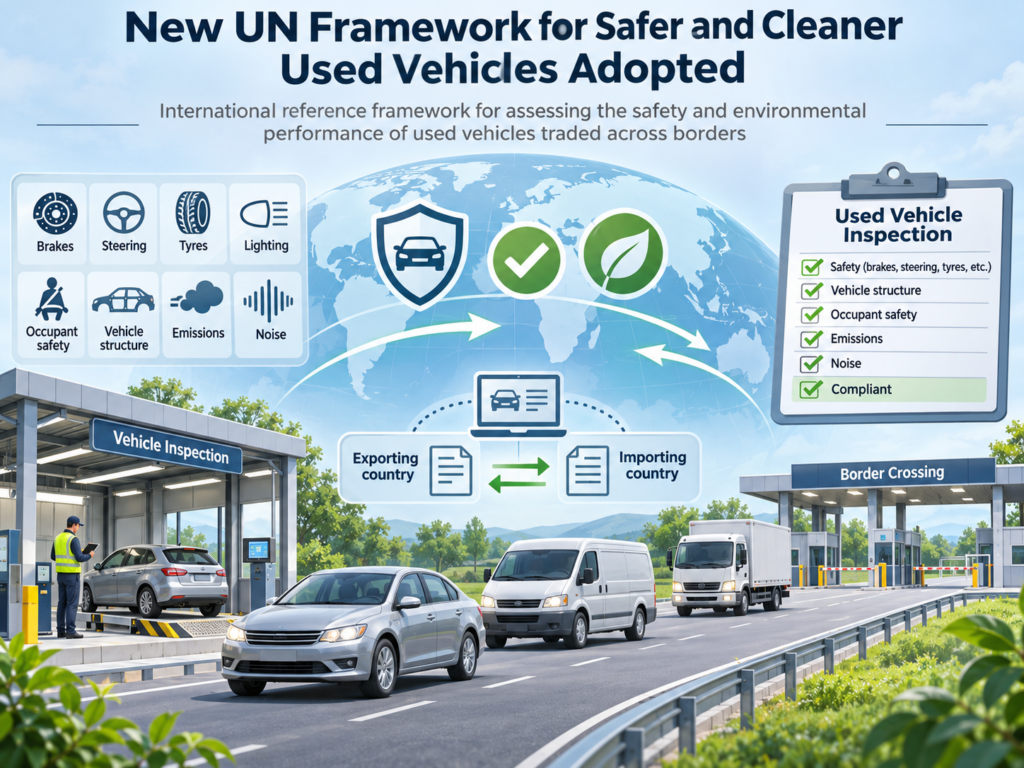
The framework establishes minimum inspection criteria covering essential vehicle systems, including braking, steering, tyres, lighting, occupant protection equipment and vehicle structure, as well as environmental requirements relating to pollutant emissions, noise and other environmental impacts.
These criteria draw upon existing UN Regulations, UN Global Technical Regulations, UN Rules and equivalent national and regional standards. They promote consistent, performance-based and technology-neutral inspection methodologies that can be adapted to different regulatory environments.
Beyond technical inspection requirements, the Resolution also encourages greater transparency and cooperation in international vehicle trade through recommended roadworthiness certification and information-sharing procedures between exporting and importing parties. These provisions can help strengthen confidence in vehicle condition assessments and support more informed decisions by national authorities.
The document provides a valuable foundation for further international cooperation on vehicle roadworthiness, including the possibility of adapting inspection requirements to emerging technologies and the growing presence of electric and hybrid vehicles.
For CITA, this achievement also demonstrates the importance of connecting international vehicle regulatory frameworks with practical vehicle inspection activities. Ensuring that vehicles continue to meet appropriate safety and environmental standards throughout their lifetime is essential, particularly when they move between markets with different regulatory requirements.
CITA welcomes this important milestone and remains committed to supporting governments, inspection organisations and international stakeholders in the implementation and future development of the framework.
The adoption of this Resolution is more than a technical achievement. It represents a landmark step towards safer roads, cleaner vehicles and better protection for road users worldwide, reaffirming that roadworthiness and environmental performance should remain priorities throughout every vehicle’s operational life.