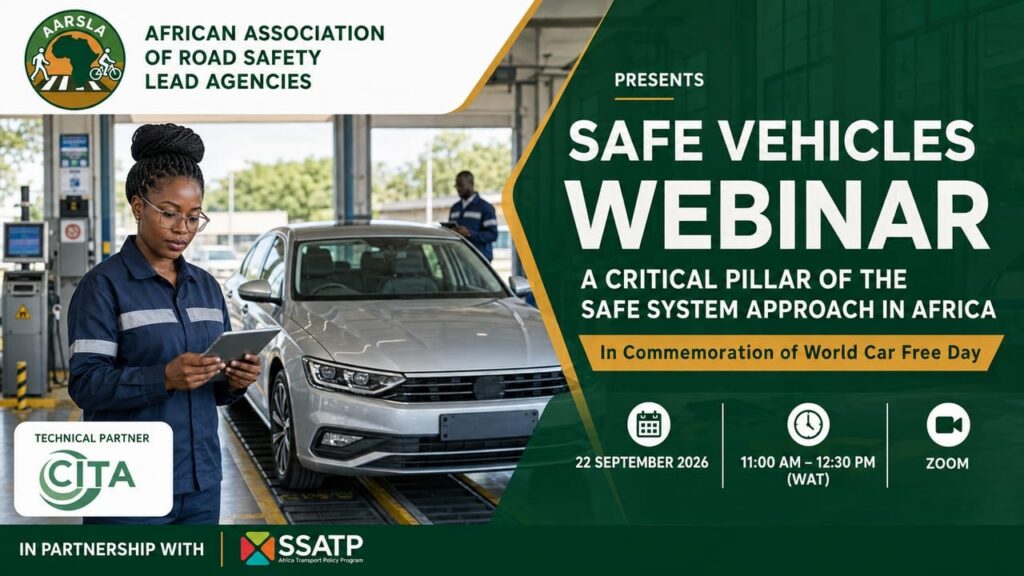
AARSLA webinar on safe vehicles and the Safe System approach in Africa
On 22 September 2026, CITA participated as technical partner in the webinar “Safe Vehicles – A Critical Pillar of the Safe System Approach in Africa”, organised by the African Association of Road Safety Lead Agencies (AARSLA) in collaboration with the Africa Transport Policy Program (SSATP).
Held in commemoration of World Car Free Day, the webinar brought together road safety organisations and technical experts to discuss how vehicle regulation, safety technologies, institutional capacity, fleet management and effective roadworthiness systems can contribute to reducing road traffic deaths and serious injuries across Africa. The programme addressed five main areas: vehicle safety standards and regulation, institutional capacity and partnerships, vehicle safety technologies, private-sector fleet management, and vehicle inspection and roadworthiness.
CITA was represented by Eduard Fernández, Executive Director, who delivered a presentation on “Institutional Capacity and Partnerships”, focusing on the role of Road Safety Lead Agencies and on how AARSLA–CITA technical cooperation can support sustained capacity development.
In his intervention, Eduard Fernández highlighted the importance of considering vehicle safety throughout the entire life of a vehicle. Vehicles undergo repairs, maintenance, modifications, changes of ownership and use, crashes and other events after entering service, making effective in-use vehicle governance an essential element of the road safety framework.
A key message of CITA’s contribution was the need to combine sound technical solutions with appropriate governance. While existing technical frameworks and international experience can be used as a basis, governance arrangements need to reflect the specific circumstances of each country.
The webinar provided an opportunity to exchange experience between road safety agencies, policymakers and technical organisations and to consider practical approaches for strengthening vehicle safety governance across African markets.