
CITA Conference on Emissions Tampering
Brussels, 13 November 2025 — CITA, in collaboration with the Danish Presidency of the Council of the European Union, successfully held the conference “A Comprehensive Approach to Fighting Emissions Tampering” at SPARKS, Brussels. The event brought together representatives from European institutions, authorities, inspection bodies, and technical experts to address one of today’s most critical challenges in vehicle compliance and environmental protection: emissions tampering.
The conference opened with welcoming remarks from Gerhard Müller, President of CITA, and Stefan Jøker Søsted, Director General of the Danish Road Traffic Authority.
In his address, Gerhard Müller underscored the moral and regulatory urgency of addressing tampering: “Tampering is not a mechanical glitch—it is a human decision that undermines fairness, safety, and environmental responsibility,” he stated. “Our inspectors cannot fight blindfolded. They must have full, secure, and standardized access to vehicle data to carry out their duty in the public interest.”
He praised Denmark’s leadership in the field and highlighted the need for Europe’s revised roadworthiness framework to empower authorities through data access, transparency, and harmonized technical standards.
Stefan Søsted extended a warm welcome on behalf of the Danish Presidency, thanking CITA for its initiative and partnership. He emphasized that cooperation and innovation are essential to achieving Europe’s green and competitive goals: “By joining forces, we are sending a clear message — that transparency, accountability, and innovation must lead the way,” Søsted noted.
He introduced Denmark’s key priorities under its Presidency — promoting a secure, competitive, and green Europe — and presented the Roadworthiness Package as a major step toward improving road safety and environmental compliance. Søsted also showcased Denmark’s pioneering use of plume chasing and OBD-based roadside inspections, illustrating how targeted enforcement and advanced technology can effectively detect tampering.


Following the opening session, the conference featured a series of high-level technical presentations highlighting practical enforcement tools and new regulatory approaches:
- Signe Shim and Jens Maegaard from the Danish Road Traffic Authority shared Denmark’s anti-tampering initiatives, including plume chasing, particle number measurements, and OBD data analysis. Their findings confirmed that tampered or defective vehicles can emit up to 40 times more NOx or particulates than compliant ones, demonstrating the efficiency of these inspection methods in real-world enforcement.
- Herbert Woopen from Opus Inspection presented the company’s advanced remote sensing technology, now recognized as a cornerstone of the proposed EU Roadworthiness Package. He detailed how remote sensing devices can identify high emitters in real time, supporting cross-border enforcement and efficient resource allocation across the EU.
- Víctor Salvachúa from Applus+ showcased Spain’s experience in periodic technical inspection (PTI) of mopeds, demonstrating how coordinated testing for light vehicles contributes to the detection of tampering and improved air quality.
- Alejandro Checa, CITA Technical Director, concluded the technical segment with a comprehensive overview of tampering across vehicle systems and regulatory frameworks. He underlined that tampering detection depends on inspection capability, training, and cooperation between authorities, manufacturers, and inspectors, and that the integration of Type Approval, In-Service Conformity, PTI, and COP processes is crucial for effective enforcement.


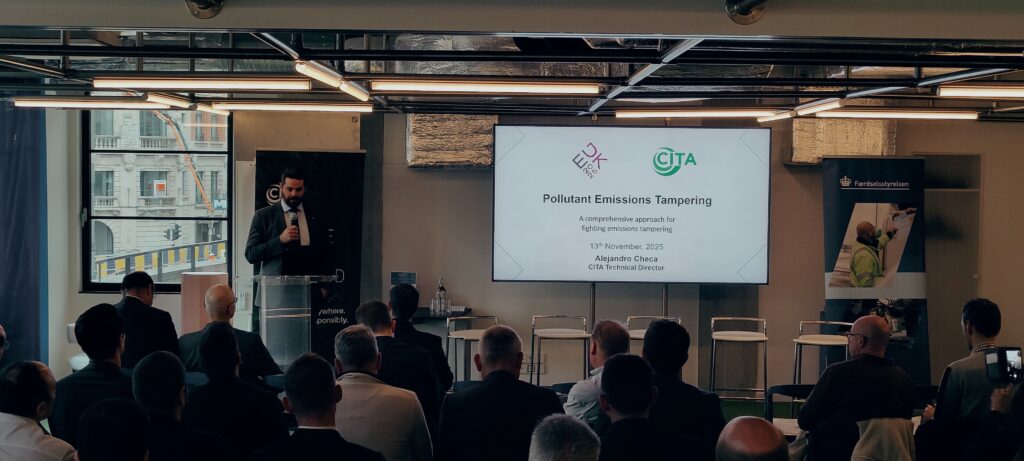

An engaging panel discussion followed, allowing participants to exchange best practices and explore synergies between national and EU-level approaches. Speakers and attendees alike agreed on the necessity of a coordinated, data-driven strategy that bridges the gap between legislation, enforcement, and inspection.


